
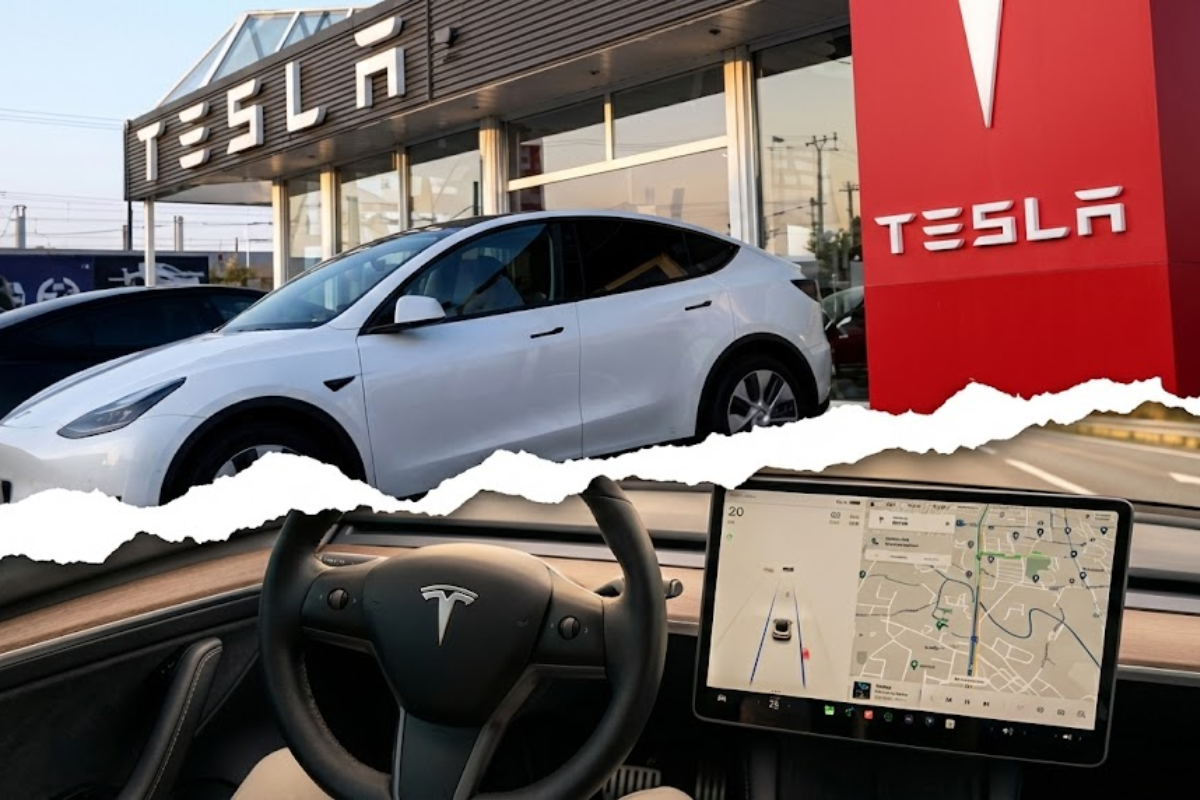
Tesla’s Full Self-Driving (FSD) subscription is a monthly AI software service that provides supervised driver-assistance features. Instead of being sold as a one-time product, FSD continuously improves through real-world driving data, frequent over-the-air updates and region-specific regulatory approvals.
Introduction: Why Tesla Changed FSD in 2026
According to public statements and repeated commentary from Elon Musk, autonomy is not a finished feature but a learning system that improves through data, iteration and scale. In 2026, Tesla aligned its Full Self-Driving strategy with this reality by completing its transition to a subscription-based model.
This was not a minor pricing adjustment. It was a structural shift rooted in how artificial intelligence actually develops.
Tesla’s Full Self-Driving subscription gives drivers access to the company’s most advanced driver-assistance software while it continuously evolves using real-world driving data. For drivers, the move lowers long-term commitment and clarifies expectations. For Tesla, it enables faster iteration, broader data collection and predictable funding for large-scale AI training.
This guide explains what changed, how the Tesla FSD subscription works, what it costs in 2026 and whether it is worth subscribing today.
Author Perspective
This analysis is based on Tesla’s public communications, observed FSD release behavior across regions and broader shifts in AI-driven software business models between 2024 and 2026.
Tesla FSD Subscription – Quick Facts (2026)
- Type: Supervised driver-assistance software
- Access model: Monthly subscription
- Autonomy level: SAE Level 2
- Driver supervision: Required at all times
- Ownership: Not transferable between vehicles
- Updates: Continuous over-the-air improvements
Why Tesla’s FSD Subscription Matters in 2026
Tesla has completed a long-anticipated transition. Full Self-Driving is no longer positioned as a permanent vehicle add-on. It is now delivered as an evolving AI service.
This matters because it reframes how autonomy should be understood. Drivers are no longer buying a static capability. They are accessing an intelligence system that learns from millions of vehicles operating across diverse real-world conditions.
For EV buyers, long-time Tesla owners, investors and technology analysts, the key questions are practical rather than speculative:
- What is Tesla’s FSD subscription
- Why did Tesla move to a subscription model
- How much does Tesla FSD cost in 2026
- Is Tesla FSD worth it
What Is Tesla’s FSD Subscription and Why Did It Change?
Tesla’s Full Self-Driving system is an advanced driver-assistance software built on camera-based perception, neural networks and real-time data processing. Despite its name, FSD is not fully autonomous and requires active human supervision.
For years, Tesla sold FSD as a high-priced, one-time purchase tied permanently to a specific vehicle. While appealing to early adopters, this model created friction:
- High upfront cost discouraged many buyers
- Ownership conflicted with continuously evolving software
- Expectations around full autonomy timelines became misaligned
By early 2026, Tesla completed its shift to a subscription-only approach in most markets. This aligns autonomy with how modern AI software is actually built, delivered and improved.
In simple terms, Tesla FSD is now accessed, not owned.
Timeline: How Tesla’s FSD Model Evolved
- Pre-2024: FSD primarily sold as a one-time purchase
- 2024–2025: Increased focus on AI training, neural network upgrades and real-world learning
- Early 2026: Subscription-based access finalized in most regions
- 2026 onward: FSD positioned as a continuously improving AI service
This evolution reflects Tesla’s long-standing view that autonomy is a learning problem, not a checkbox feature.
Tesla FSD Subscription Cost in 2026
Tesla does not publish a single global price for its Full Self-Driving subscription. Pricing varies by market and may change as features evolve and regulations shift.
As of 2026:
- In the United States, Tesla FSD has historically been priced in the $99–$199 per month range
- European and Asian markets may see different pricing due to regulatory constraints
- Some older vehicles or regions may still reference legacy one-time pricing, though new purchases are largely subscription-based
Tesla intentionally keeps pricing flexible, reflecting FSD’s status as evolving AI software rather than a finished product.
Why Tesla Cannot Sell FSD like Traditional Software
Traditional software can be shipped, owned and left unchanged. AI systems cannot.
By 2026, the main bottlenecks in autonomous driving are data scale, real-world variability and continuous learning across regions.
Tesla’s autonomy loop works as follows:
- Vehicle hardware enables data collection
- Real-world data trains neural networks
- AI improves driving behavior
- Improved performance attracts more users
- More users generate higher-quality data
Selling FSD once breaks this loop. Subscription access keeps it active and compounding.
Why Elon Musk Supported the Subscription-Only Model
From a strategic standpoint, this move is inseparable from Tesla’s AI roadmap.
On January 14, 2026, Elon Musk shared an official statement on Tesla’s transition to a Full Self-Driving (FSD) subscription model via X (formerly Twitter).
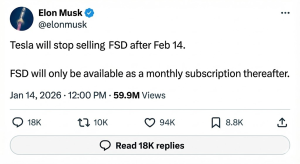
Tesla will stop selling FSD after Feb 14.
FSD will only be available as a monthly subscription thereafter.
— Elon Musk (@elonmusk) January 14, 2026
Tesla does not treat FSD as traditional software. It treats it as a learning system trained on billions of miles of real-world driving data. Every update refines perception, prediction, and decision-making.
The subscription model supports this strategy in three key ways:
- Lowering the barrier to entry, increasing participation and data diversity
- Creating predictable recurring revenue to fund AI compute and training
- Setting realistic expectations by framing FSD as evolving intelligence
This is not about monetization shortcuts. It is about building autonomy the way AI systems actually mature.
How the Tesla FSD Subscription Works
The Tesla FSD subscription provides access to Tesla’s most advanced driver-assistance features while the subscription remains active.
Eligible vehicles can activate FSD through the in-car interface or Tesla mobile app. Once enabled, the software integrates with existing hardware and receives frequent over-the-air updates.
Drivers can start, pause or cancel the subscription at any time.
The key takeaway is simple. You pay for access when you use it, not for speculative future capability.
Tesla FSD Subscription vs Traditional Driver-Assistance Systems
Tesla FSD differs from other driver-assistance systems in approach:
- Tesla FSD emphasizes vision-based learning and large-scale real-world data
- GM Super Cruise relies heavily on mapped highways and geofenced routes
- Mercedes Drive Pilot focuses on limited but legally approved autonomy in controlled conditions
Tesla’s strategy prioritizes scalability and learning speed over early hands-free operation.
Is Tesla FSD Worth It in 2026?
For many drivers, Tesla FSD is worth it in 2026, provided expectations are realistic.
Good fit for:
- Daily or long-distance commuters
- Urban drivers dealing with complex traffic
- Technology-focused users who value frequent updates
Not ideal for:
- Drivers expecting hands-free autonomy
- Infrequent drivers
- Buyers who strongly prefer one-time purchases
FSD remains a driver-assistance system. Active supervision is still required.
What This Means for the Next 3–5 Years
Tesla’s shift to subscription-based autonomy signals a broader industry trend. Autonomous driving will advance incrementally, region by region, driven by data rather than announcements.
Subscription access allows Tesla to scale learning globally without locking users into outdated assumptions. This is not about predicting robotaxis tomorrow. It is about building reliability today.
Key Takeaways
- Tesla FSD is now delivered primarily through subscription access
- The model supports continuous AI improvement
- Drivers gain flexibility and clearer expectations
- Tesla gains scale, data and predictable revenue
- This reflects the future of software-defined vehicles
Frequently Asked Questions
What is Tesla FSD subscription?
Tesla’s Full Self-Driving (FSD) subscription is a monthly software service that provides access to Tesla’s most advanced driver-assistance features. While active, it enables supervised driving functions that continuously improve through over-the-air updates and real-world driving data. FSD remains an assistance system and requires active driver supervision at all times.
How much does Tesla FSD subscription cost in 2026?
Tesla does not publish a single global price for FSD. Pricing varies by region and may change over time. In the United States, historical monthly pricing has generally ranged between $99 and $199, depending on vehicle eligibility, feature availability, and regulatory conditions. Prices in other regions may differ due to local regulations.
Is Tesla FSD fully autonomous?
No. Tesla FSD is not fully autonomous. It is classified as a supervised driver-assistance system and requires the driver to remain attentive, keep hands ready to take control, and intervene whenever necessary. Tesla does not currently offer unsupervised self-driving for consumer vehicles.
Can the Tesla FSD subscription be cancelled?
Yes. Tesla FSD subscription can be cancelled at any time through the vehicle’s in-car interface or the Tesla mobile app. Once cancelled, FSD features remain active until the end of the current billing cycle and can be re-activated later by re-subscribing.
Will Tesla eventually achieve full autonomy?
Tesla continues to develop autonomous driving technology, but achieving full autonomy depends on both technological readiness and regulatory approval. Progress is ongoing, and timelines remain uncertain due to the complexity of real-world driving and varying legal frameworks across regions.
Does Tesla FSD subscription transfer to a new Tesla if I change my car?
No. Tesla’s FSD subscription is tied to the specific vehicle while the subscription is active. If you sell or replace the car, the subscription does not transfer and must be activated separately on the new vehicle.
What happens if I cancel Tesla FSD subscription and re-subscribe later?
If you cancel Tesla FSD, the advanced driver-assistance features are disabled at the end of the billing period. You can re-subscribe at any time, and access will be restored, typically with the latest available software version.
Does Tesla FSD work better on highways or city streets?
Tesla FSD generally performs more smoothly on highways due to predictable traffic flow and lane structure. City streets involve more complex scenarios, such as pedestrians and unprotected turns, and require closer driver supervision.
Can Tesla remove or change FSD features after you subscribe?
Yes. Because FSD is a subscription-based AI service, Tesla can modify, add, or temporarily restrict features through software updates based on safety, performance, or regulatory requirements.
Does Tesla FSD subscription increase the resale value of a vehicle?
The subscription itself does not permanently increase resale value because it is not owned. However, active FSD access at the time of sale may make a vehicle more attractive to buyers, depending on market demand.
Final Thoughts
Tesla’s move to a Full Self-Driving subscription is not about selling autonomy. It is about earning it.
For drivers, the model offers flexibility and transparency. For Tesla, it enables continuous learning at scale. For the industry, it signals how intelligence will be delivered in the decade ahead.
The FSD subscription is not a pricing update. It is a structural reset in how vehicles learn.