
Introduction: Why Predicting Ad Performance Matters
You know that feeling when you launch an ad campaign and hold your breath waiting for results? Weeks go by, you stare at dashboards, and sometimes the ads that seemed perfect flop completely. Other times, a random creative surprises you and performs way better than expected.
Imagine if you could skip all that stress. That’s what AI ad performance prediction promises. It gives marketers a glimpse into what will likely work before you spend a single rupee. You’re not guessing anymore; you’re planning with confidence.
For business owners and CMOs juggling multiple campaigns, this is a huge relief. It saves time, reduces wasted budget, and helps focus on what truly moves the needle.
Understanding AI Ad Performance Prediction
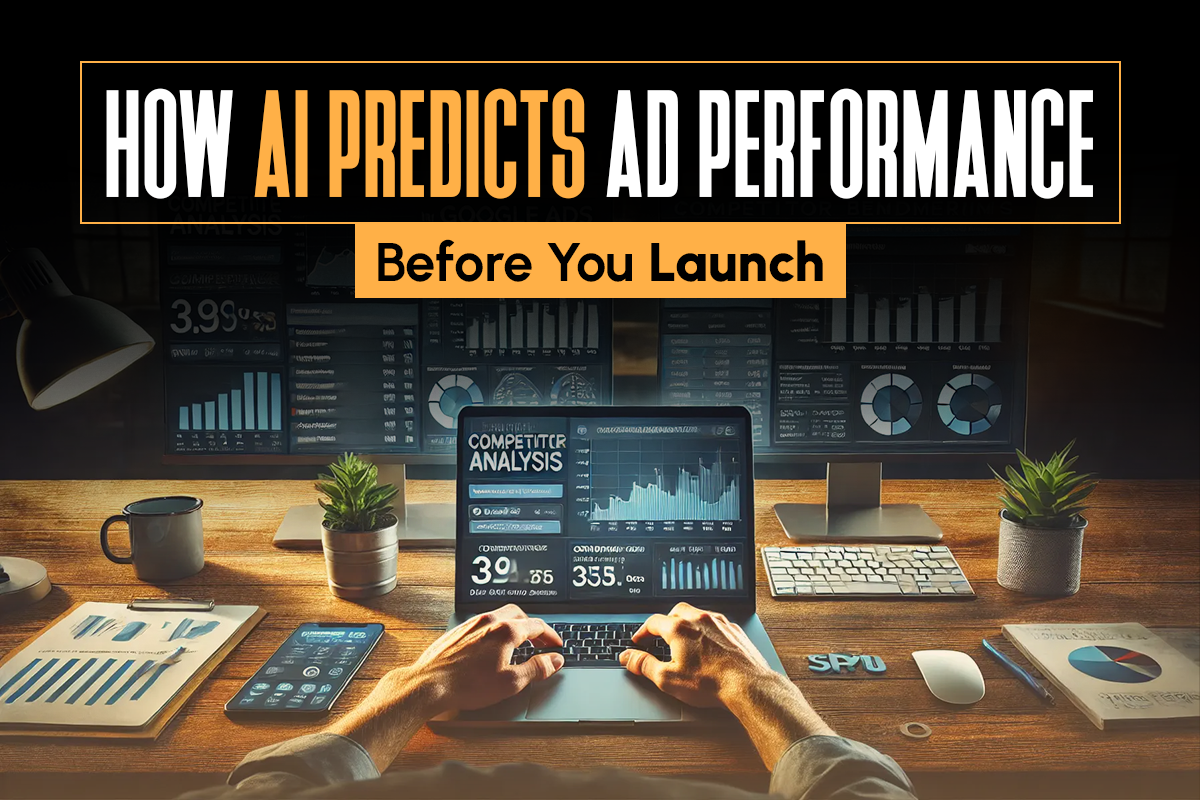
At its simplest, AI ad performance prediction is about letting a system study patterns from past campaigns and audience behaviors, then use that knowledge to forecast future performance. Think of it as a very experienced strategist who never sleeps and remembers every campaign you’ve ever run.
AI looks at things you might not even notice:
- Which headlines catch attention
- Colors that drive clicks
- Image types people pause to look at
- Audience actions across devices and platforms
By combining all this data, AI can predict which creatives will likely get engagement, clicks, or conversions. It’s not magic, it’s pattern recognition on steroids.
From Interest to Intent: Audience Behavior Insights
Not all clicks are created equal. Someone scrolling by may just be curious, while another user is genuinely considering a purchase. AI can differentiate between these behaviors by spotting intent signals.
For instance, a user who checks multiple product pages, reads reviews, or adds items to the cart shows strong intent. AI identifies these micro-behaviors and tells you where to spend your budget for maximum impact.
It’s like having a personal shopper for your ads, pointing you straight to the high-intent customers. No more wasted impressions, no more blind guesses.
Psychology Behind Predictive Advertising
AI doesn’t just crunch numbers. It applies psychology to advertising too. Humans respond predictably to certain triggers, and AI can spot which combinations are most likely to resonate.
Some examples:
- Limited-time offers create urgency
- Social proof like reviews or ratings builds trust
- Warm colors often spark action while cooler tones convey reliability
- Visual hierarchy guides eyes naturally to the CTA
By combining psychology and historical data, AI forecasts which ad versions will likely perform best. It’s like having a psychologist on your marketing team.
Strategies for AI-Powered Campaign Success
Here’s how to make the most of AI predictions:
- Start Small: Test predictions with a portion of your budget first. See if the AI forecast matches real-world results.
- Mix Creative and Performance AI: Use AI to generate multiple creatives and to forecast which one will perform best.
- Feedback Loop: Feed actual campaign results back into the AI system to improve future predictions.
- Platform Awareness: AI tools excel in certain platforms. Use the right tool for Facebook, Instagram, TikTok, or search.
- Focus on Conversions: AI is most powerful for lower-funnel ads and retargeting where performance is measurable.
Comparison Table of Top AI Tools
|
Tool |
Best For |
Key Features |
Accuracy |
Ease of Use |
|
Pattern89 |
Social media |
Creative forecasting, image & copy analysis |
95% |
Medium |
|
Madgicx |
Performance marketing |
CTR prediction, audience insights |
90% |
Easy |
|
Genus AI |
Lower-funnel ads |
Automatic creative generation |
92% |
Medium |
|
AdGPT |
Campaign forecasting |
Budget optimization, trend analysis |
88% |
Easy |
|
Custom ML Models |
Enterprise |
Proprietary predictions |
85–95% |
Hard |
Case Studies & Real-World Examples
- E-commerce Brand: Reduced A/B testing costs by 60% using AI predictions. The campaign exceeded expected ROAS by 35% in the first week.
- Food Delivery Platform: Seasonal campaigns were predicted by AI, allowing budget allocation to high-intent audiences. Conversions increased 28%.
- Fashion Retailer: Automated ad creation and prediction saved weeks of testing while boosting click-through by 22%.
Practical Tips to Maximize ROI
- Feed AI with high-quality past campaign data
- Test multiple creative versions and let AI pick the winner
- Track predicted vs actual performance to refine your model
- Target high-intent audiences AI identifies
- Always adapt AI insights to platform-specific nuances
Conclusion
AI ad performance prediction isn’t the future. Its here and working. For marketers, CMOs, and business owners, it’s like having a crystal ball that actually works. You save time, reduce budget waste, and increase conversions.
Those who embrace AI now gain a serious edge over competitors. Start small, test, learn, and scale intelligently.
FAQs
1. What is AI ad performance prediction?
It’s using AI to forecast which ads will perform well before launch based on past data, creative elements, and audience behavior.
2. How does AI help performance marketing?
It identifies high-performing creatives, spots high-intent audiences, allocates budgets effectively, and reduces guesswork.
3. Which tools are best for predicting ad performance?
Pattern89, Madgicx, Genus AI, AdGPT, and custom enterprise models. Each tool focuses on different platforms and use-cases.
4. Can AI guarantee ad success?
No. AI reduces risk and improves predictions but real-world testing is still necessary.
5. How does predictive advertising save money?
By showing you which ads are likely to fail and which will convert, so you invest your budget wisely.
6. How does psychology factor into AI predictions?
AI considers visual cues, messaging, urgency, social proof, and color psychology to forecast audience reactions.
7. Is AI only for big brands?
Not at all. SMEs can use AI tools to compete effectively with larger brands and make smarter marketing decisions.