
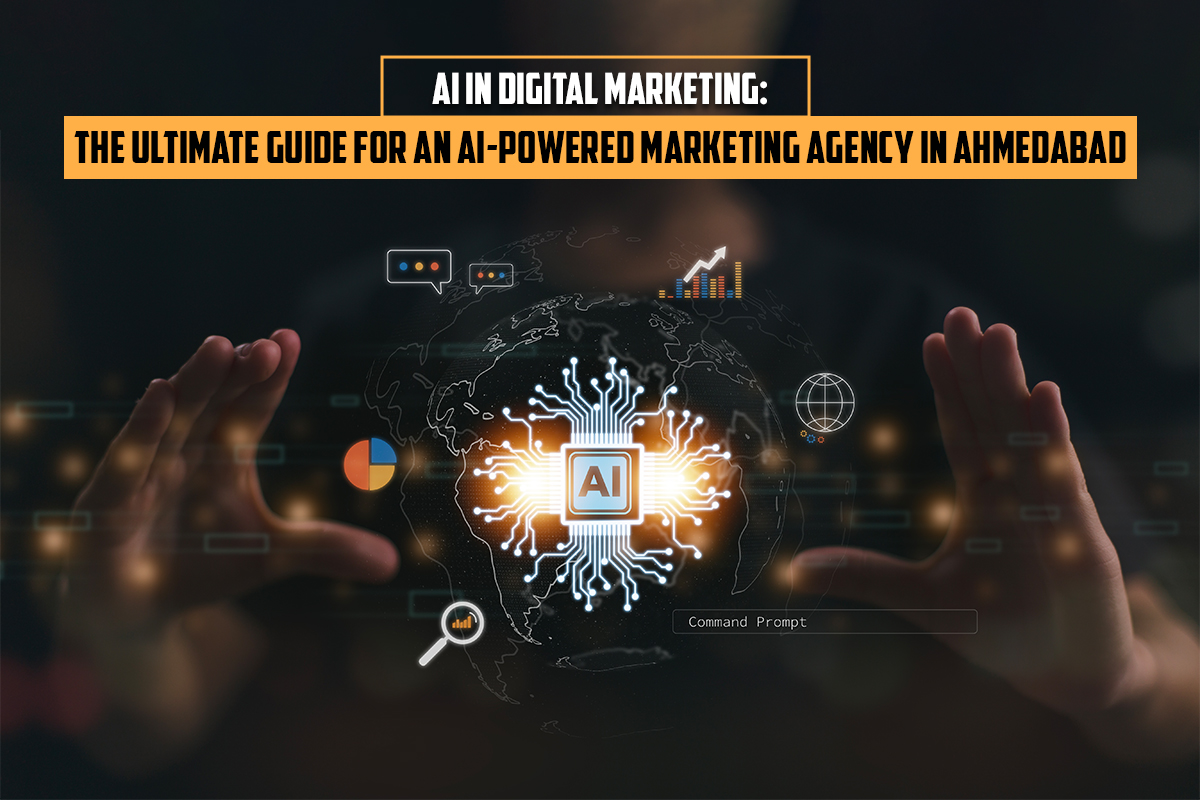
AI-driven digital marketing agencies use data, automation and AI Productivity Tools to enhance how marketing works. They don’t rely only on manual planning, they analyse real user behavior to predict actions and optimize campaigns continuously. This helps businesses run smarter, more marketing targeted. And it improves over time, reduces guesswork and delivers better results without restarting strategies for every campaign
The Rise of AI in Digital Marketing
Artificial intelligence is now moved beyond being just a side tool, it is becoming a core part of marketing operations. For an AI-powered digital marketing agency in Ahmedabad, the real value of AI is not hype or novelty. It’s the ability to make marketing more precise, more personal and easier to scale.
In actual terms, AI helps teams understand audiences faster, predict what people may do next and automate repetitive work that used to slow campaigns down. According to recent industry research from McKinsey and Salesforce: marketers are aggressively increase using AI and personalization at scale. While HubSpot’s 2026 research shows that AI is widely adopted in content and media creation.
What is AI in digital marketing?
The term AI in digital marketing just refers to the application of machine learning algorithms, predictive models, natural language processing and automation to enhance the planning and execution of marketing. Unlike manual analysis, AI systems can analyze extensive data and discover trends that are difficult to identify manually.
That matters because most digital marketing work is already data heavy. Search behavior changes, ad performance changes and customer intent changes. AI helps marketers react faster and make decisions based on evidence rather than assumption.
In simple terms, AI turns marketing from a one-time activity into a learning system.
Why AI matters for businesses in Ahmedabad
Ahmedabad has a fast moving business environment. Local brands, startups, service companies, healthcare, real estate firms and ecommerce stores all compete for online attention. So, in that kind of market, brand can’t afford slow or generic kind of marketing
AI becomes useful because it helps businesses do three things better:
- understand local customer behavior
- respond faster to demand changes
- improve efficiency without increasing manual workload
That is particularly relevant for businesses working with limited time and budgets. They don’t need to running broad campaigns and hoping something works, they can use AI to focus on the audience, message and channel most likely to perform.
How AI is changing the way marketing works
AI is not changing just one part of marketing. It is changing the whole workflow.
Better audience targeting
Conventional targeting usually begins with generalized assumptions like age, area, or position. AI goes a step further by examining the trends in browsing, clicks, and engagement and purchase indicators.
That means a campaign can target users based on likely intent, not only demographics. The result is usually cleaner segmentation and better lead quality. Mailchimp and other marketing platforms describe AI-driven personalization as a way to use large datasets to detect patterns and predict intent.
Smarter personalization
Personalization has moved from the use of first name in an email. According to McKinsey, AI and generative AI have the potential to assist marketers in scaling pertinent messages, tone, imagery and experiences in large groups.
It means that a certain user might be exposed to a product suggestion, another might be exposed to a different headline and another one might be exposed to a different email sequence depending on the behaviour. This is what makes modern marketing feel more relevant.
Faster optimization
AI also improves how campaigns are adjusted. Instead of waiting for end-of-week reports, marketers can monitor performance and shift budget, content, or targeting sooner.
Salesforce’s current State of Marketing research shows that marketers are placing major focus on AI, data and personalization, which reflects how central optimization has become in modern teams.
More efficient content workflows
According to HubSpot 2026 marketing research, AI is actively utilized in creating content and producing media, and this is an indication of how popular AI-assisted processes have become.
This does not imply that content should be left to the automation process. It implies AI can assist teams in research, outlines, variations, briefs and production assistance and human beings in strategy, judgment and final quality.
Where AI is used in digital marketing
AI shows up in almost every channel now, but some areas benefit more than others.
SEO and search strategy
AI assists marketers to identify keyword opportunities and cluster topics and content gaps. It is particularly handy when developing predictive SEO mechanisms, where it is not so much to rank what is already trending but to be ready to rank what users are likely to search at the next time.
AI also helps with:
- intent analysis
- semantic keyword mapping
- content refresh planning
- competitor pattern detection
This is one reason search teams are using AI to support planning, not just writing.
Paid advertising
AI is very effective in paid media because ad platforms generate a large amount of signal.
It can help with:
- audience selection
- bid adjustments
- creative testing
- budget optimization
The useful part is not automation for its own sake. It is the ability to reduce waste and increase the chance that spend goes to the best-performing combinations.
Email marketing
Email is one of the clearest examples of AI marketing automation. Mailchimp notes that automation is widely used for email management and AI can help personalize subject lines, triggers and message timing.
Instead of sending the same message to everyone, AI can support sequences based on:
- sign-up behavior
- cart abandonment
- product interest
- prior engagement
That is much closer to real one-to-one marketing.
Chatbots and customer support
AI chatbots are now a common part of customer experience. They answer routine questions, qualify leads and guide users to the next step. HubSpot’s AI statistics also point to strong growth in chatbot-related use cases.
For businesses, this means faster response times and fewer missed leads after business hours.
Social media and content planning
AI helps social teams analyze engagement patterns, suggest post ideas and identify content formats that perform better. It can also support repurposing, which is useful when one strong idea needs to be adapted across platforms.
The important part is judgment. Though AI can suggest structure and variation, but the message must needs a human voice.
Benefits of AI in digital marketing
The benefits are strongest when AI is used as a system, not as a gimmick.
Better speed
AI cuts down the time spent on repetitive tasks such as reporting, tagging, basic segmentation and drafting variations. That gives marketers more time for planning and analysis.
Better efficiency
When campaigns are optimized continuously, teams waste less money on weak audiences or poor-performing creatives. That makes budgets work harder.
Better personalization
Customers are more likely to engage when messages match their interests and behavior. McKinsey’s 2025 personalization research highlights this as one of the biggest reasons AI matters in marketing.
Better decision-making
AI supports better decisions because it turns scattered data into usable insight. Marketers can see what is happening sooner and act with more confidence.
Better scale
This is one of the biggest reasons larger teams invest in AI. McKinsey’s 2025 State of AI research says organizations are still working to move from pilots to scaled impact, which shows that the real value comes when AI is built into operations, not kept as an experiment.
Risks and limitations businesses should understand
A useful blog should also be honest about the limits.
Bad data leads to bad output
The strength of AI is as strong as the data it is fed with. When the data of origin is not clean, not complete and up-to-date, the findings are not trustworthy.
Over-automation can reduce trust
When it all becomes robot-like, the brand becomes personality-less. Even human editing is a concern in the tone, nuance and context.
AI can miss market-specific detail
The model can acquire patterns, but not necessarily the local business reality, cultural subtleties, or customer emotion that a person possesses.
Compliance matters
A business should be cautious of privacy and consent when collecting and utilizing customer data. AI simplifies the processing, but does not eliminate responsibility.
Which types of businesses can be most advantageous with AI marketing?
AI is useful across industries, but some business types see especially clear value.
Ecommerce brands
AI helps with product recommendations, abandoned cart recovery, dynamic ad targeting and personalized offers
Real estate businesses
It supports lead scoring, follow-up automation and audience targeting based on buying intent.
SaaS companies
AI is able to enhance trial-to-paid conversion, onboarding emails, feature adoption and churn prevention.
Healthcare and clinic
It can help with appointment reminders, local search visibility and patient communication.
Education and coaching businesses
AI is useful for lead nurturing, content segmentation and course promotion.
For businesses in Ahmedabad, this mix matters because many local companies operate in exactly these categories.
What skills marketers need now
The rise of AI does not reduce the need for marketers. It changes the skill set.
The most useful skills now include:
- data interpretation
- content strategy
- campaign analysis
- audience segmentation
- prompt thinking
- automation planning
- SEO and search intent analysis Both HubSpot and Salesforce studies indicate that marketers are moving to work with AI and data and personalization in unison, and thus the position is becoming more strategic, rather than less.
The future of AI in digital marketing
The future is shifting towards being more predictive and more adaptive in marketing.
A few trends are already clear:
- more personalization at scale
- more automated campaign decisions
- more use of AI for creative production
- more emphasis on intent-based search
- more demand for human oversight and trust
In other words, the winning teams will not be the ones using the most tools. They will be the ones using AI with the most discipline.
Final thoughts
AI in digital marketing is no longer about experimenting with a new tool. It is about improving how marketing is planned, executed and measured.
For an AI powered digital marketing agency in Ahmedabad, the strongest position is not “we use AI.” The stronger position is: we use AI to make marketing clearer, faster and more useful for the business and the customer.
That is what search engines reward now too: content that is complete, useful, specific and written for real people. Research from McKinsey, Salesforce, HubSpot and Mailchimp all points in the same direction: AI works best when it supports personalization, automation and better decision-making rather than replacing strategy.
Frequently Asked Questions
What do you mean by an AI-powered digital marketing agency?
A digital marketing agency is an AI-based agency, which utilizes machine learning, data analysis, and automation to enhance marketing. It does not use manual planning alone but takes a glimpse of the real data to know what users are doing and what they are likely to do next. This assists businesses to conduct smarter campaigns which they can enhance over time, instead of having to initiate each time.
What are the benefits of AI to digital marketing outcomes?
AI enhances marketing primarily by assisting you to make superior choices, quicker. It is able to process huge volumes of data and identify patterns otherwise hard to identify by hand. Due to this, businesses are able to reach out to the right audience, make amendments on campaigns at the right moment, and provide more pertinent information. This will eventually result in increased engagement and higher conversion rates.
Can AI marketing be of benefit to small businesses in Ahmedabad?
Yes, it is even more practical to small businesses in numerous cases. Rather than spending more money on advertisement, AI assists companies to utilize their funds more effectively. It targets the audience with the highest chances of conversion, saves on unnecessary expenses and automates repetitive functions which consume time. This can easily make a difference in cost as well as the outcome to growing businesses in Ahmedabad.
What are the key advantages of AI in online marketing?
The largest advantage of AI is that it takes much of the guesses out of marketing. It assists businesses to know more about their audience, react more quickly to alterations and execute campaigns more effectively. Jobs that would have taken hours to complete can now be completed in a much faster time and decisions are made based on real data and no longer assumptions. This will result in high performance and more reproducible outcomes in the long term.
What are the drawbacks of AI in marketing?
AI is beneficial, yet not flawless. It relies greatly on the standard of data. In case the information is not complete or not accurate, the information will not be accurate. It is also time consuming to install and even requires human input in terms of strategy, creativity and context. Simply said, AI is most effective when it aids human thinking, rather than supplants it.